It may seem time-consuming to plan your essay, but to ensure that you cover all the learning objectives, that you are not repeating yourself, and that you’re putting the research in, it’s vital.

You need to make sure that you are reading before you start doing
your first proper plan. It’s going to give you a lot more insight and allow you to synthesise your ideas better.
Stage 1: Brain dump
Write down everything you know related to the
assignment title. You can use anything to write on.
I think writing on paper is optimal, and for me it’s using A3 and lots of colours.


Stage 2: Reading the gaps
Use your brain dump to help you identify the gaps in your knowledge. You can then use this to target your reading, and don’t forget to use the reading tables above to help you track what you have read and the key concepts within that reading.
Stage 3: Planning
You are now ready to start to identify things within the assignment and have an idea of what you want the assignment to look like.

PEEEL Paragraphs: A PEEEL paragraph gives you a structure to
stick to and allows you to ensure you are being critical.
P – Point
State the argument or topic of the paragraph.
Single-use plastics pose a direct physical threat to the survival of various marine species.
or
One major difference between theories of memory is how they explain the structure and storage of information.
Sentence starters
A key issue in …
Existing research …
E – Evidence
Back up your point, use your research.
Research indicates that over 100 million marine animals die
each year from plastic waste (Packham, 2025).
or
The Multi-Store Model proposed by Richard Atkinson and Richard Shiffrin (1969) suggests that memory is
divided into separate stores: sensory memory, short-term memory, and long-term memory. In contrast, the
Working Memory Model developed by Alan Baddeley and Graham Hitch (1974) argues that short-term
memory consists of several active components, including the phonological loop and visuospatial sketchpad.
Sentence starters
Research into how children learn to read has a long history.
Snowling (2008) examined …
According to Anderson and Pearson (1984) …
Whilst Coltheart et al. (2001)
E- Explain
Explain how the evidence supports your point.
This staggering figure stems from animals mistaking debris for
food, which leads to internal blockages or starvation.
or
However, although the Working Memory Model is considered more sophisticated, the Multi-Store Model remains influential because it established the idea that memory involves separate systems with different functions. Nevertheless, critics argue that the Multi-Store Model oversimplifies memory by assuming that short-term and long-term memory are unitary stores.
Sentence Starters
This shows that …
Therefore, …
This directly supports …
For instance, …
This is important because …
E – Evaluate
How effective, reliable, or significant is this?
While individual deaths are tragic, the broader evaluation
suggests that the true danger lies in the “bioaccumulation” of
microplastics. While a plastic bag might kill one turtle,
microplastics infiltrate the entire food chain from the bottom
up. Therefore, focusing only on large, visible debris might lead
to a superficial understanding of the crisis, as the invisible
chemical and microscopic degradation of plastic is arguably a
more permanent threat to global marine ecosystems than the
physical objects themselves.
Sentence Starters
A strength of this argument is …
The study by … is weakened by its reliance on …
While Coltheart focuses on dual route theory, Snowling highlights phonological deficits …
This view is critical as …
L – Link
Create connections to your next paragraph.
Consequently, conservation efforts must evaluate the problem
as a systemic chemical threat rather than just a waste
management issue if they are to be truly effective.
or
Overall, while both theories attempt to explain how memory operates, the Working Memory Model offers a
more complex and flexible understanding of short-term memory processes.
Sentence Starters
Overall …
Another significant …
In contrast to Snowling …
On the other hand …
Backwards Planning
Backwards planning is a strategy where you start with the end goal, actually submitting your assignment on the due date, and then you work backwards to see what you need to do.
It prevents procrastination and eliminates panic as you know when you need to start the assignment, it gives you the time that you need to be able to formulate, think about your assignment, and edit it so it goes in without typos.
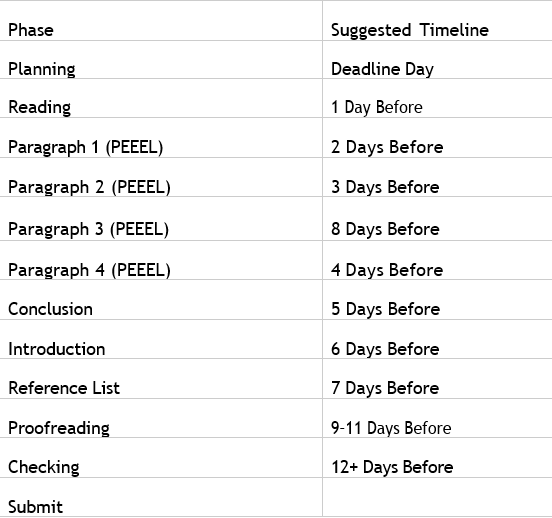
This is an example of how backwards planning can work:
- Mark the deadline in your calendar, whether that be digital or physical, and then work backwards for each section.
- Put a note the day before the deadline in your calendar that you need to check the completed assignment. Two days before that, you need to proofread it, and so on.
- Whilst the timescales on the pages following are guidance only, they are a good place to start.
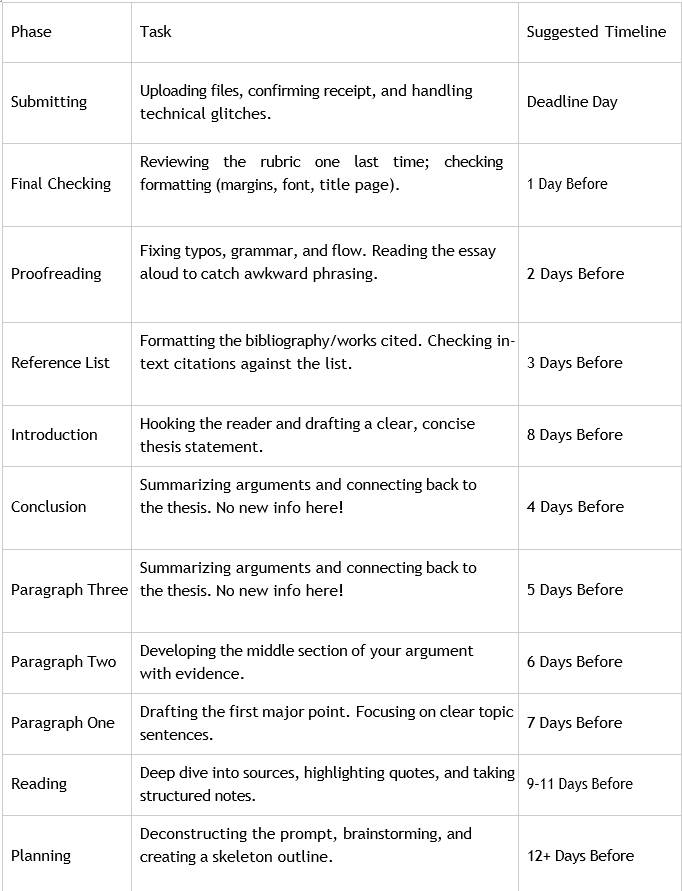
You can then create a plan the right way around!